The following is part of a photographic series, People at Work: The Low Wage Earners of Maine, which depicts some of our fellow neighbors who work for the state’s minimum wage of just $7.50 an hour. The dedicated photographer, Jeff Kirlin, works in his free time documenting them. This is just a sample from his series.
“The photography project was started after I was told by a person, in a position to help bring about a higher minimum wage, that he didn’t feel it was a real problem because it hasn’t been brought to his personal attention,” said Jeff, a speech therapist and Bangor based photographer. “This project is intended to give, not a voice, but a platform for those earning low wages and their supporters, and how their lives are affected by stagnant wages.”
Please consider sharing these images. #MaineLivingWage #RaiseTheWage

“My goal is to help bring meaningful reform to our criminal justice system in America. I want to put an end to this country’s school to prison pipeline that so many minorities and people living in poverty face.
Ya know, I really do love my job; not many people my age can say that. However, I’m in a situation where I can’t go back to college because I have bills to pay. I’m constantly being pressured by my family to go back to school, but how am I supposed to balance a college education with rent? It’s frustrating being criticized by some of the people you love most, but what’s even worse is having to delay my goals because I work for less than $9 an hour. How am I supposed to help those living in poverty when I can’t even find a way to get out of poverty myself?”
-Jensen Cook

“I work in healthcare, one to one with patients and we earn below a living wage. When you are a patient, the person you see the most is the one who is paid the least. If going into healthcare wasn’t one of the most rewarding things I have ever done… it wouldn’t be worth it.”-McKenzie Chambrello

“I’ve had a job since I was 7 years old. Mowing lawns, raking leaves, paper route, custodial work in middle school and high school. Many overlapping. I was raised with what most would call a strong work ethic. Last year I was laid off twice. The second time was in the dead of winter when virtually no one was hiring. I had to take some humble jobs. After the first night at one job, I was so tired and so sore, I cried myself to sleep, overwhelmed by my new reality. After a month of working every hour the business could spare me, I had made $500. I was falling farther and farther behind. I was very fortunate to be given an opportunity by a local family business just as things were at their bleakest. I feel very lucky to be where I am. Many people never get that.”
-James Reiss

“I’ve worked at this particular location at near-minimum wage for 2 years. Only part-time, though — so I can be home with my two young children during the day so my husband can work full time. Despite the pay, I’m happy to be there. The hours and schedule are flexible, and I’ve met some amazing people. Without my husband’s career, however, it wouldn’t be possible for me to work there. If you account for the travel and food, I don’t contribute much financially. Without Joshua’s career, We’d be obligated to seek state help, and I’d be working double-triple the hours to make ends meet.
Like so many other Mainers, We live on a budget — more so during the winter. My job is one I’m grateful to have; even if the pay is modest. We balance and make do for ourselves, and our children.
Growing up, I was always told to work hard and get the career I wanted. Go to college, earn a career that you’re proud of. But, What’s completely flawed about that is the implication that a minimum wage job isn’t something to be proud of.”-Sarah Giles

“Raising the minimum wage means much more than a blue coat. When I got up to speak last night, I wanted to say so much. I mentioned my college education, how I felt I fought for it, for nothing, then realized NO ONE could take my education from me!
“I spoke of transportation. $2.00/hr increase in minimum wage, would have afforded that simple luxury of having a bus ticket.. Instead, I made the 2 mile trek, one way, to work every day I was scheduled, and when I was called in, I went. On that first huge storm I was angry, scared, and relieved. I made it safely! (Thank you city of Bangor) Minimum wage, like every job, I felt stuck, I am over qualified, because I now have a college education. I am under qualified, because I have no experience. An employer is going to take a new graduate, over one who has been out of the field. The job search is much harder these days. It’s all about looking good to a computer, not who you know, and first impressions.”-Melissa L Connors

“When I started my last job, in 1999, I was making about ten thousand a year. When it went out of business at the start of 2014, I was making about fourteen thousand. If you adjust for inflation, I didn’t really get a raise over those fifteen years and was always just a hair’s breadth over the official poverty level.”-William Young

“It’s really hard to find a job you love and are good at that pays above minimum wage these days. I started as a cashier and got promoted to a team member with COSA rights — but I didn’t get a promotion in wage. I had more responsibilities but was getting paid the same wage as a cashier. Its sad, I really liked my job and the people I worked with but I couldn’t continue living paycheck to paycheck on a minimum wage salary. For the record, of it makes anyone feel better —I was getting paid minimum wage with a college degree in hospitality management. When someone with their college degree can’t even find a job that pays over minimum wage, then you know that something needs to change.” -Chelsea Cyr
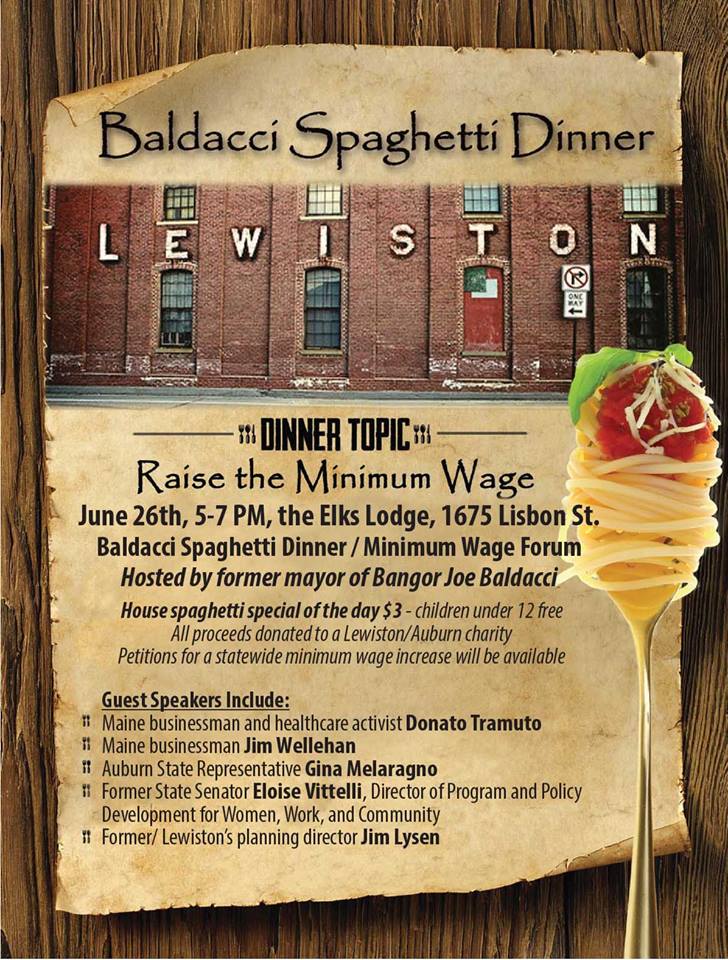 Former Bangor Mayor Joe Baldacci is hosting a spaghetti dinner/minimum wage forum on Friday June 26th at the Elks Lodge #371, 1675 Lisbon Street in Lewiston, from 5pm-7pm.







 Jobs and Justice in Maine