Baldacci Spaghetti Dinners/Minimum Wage Forums hit the road

First appeared in the Bangor Daily News HERE

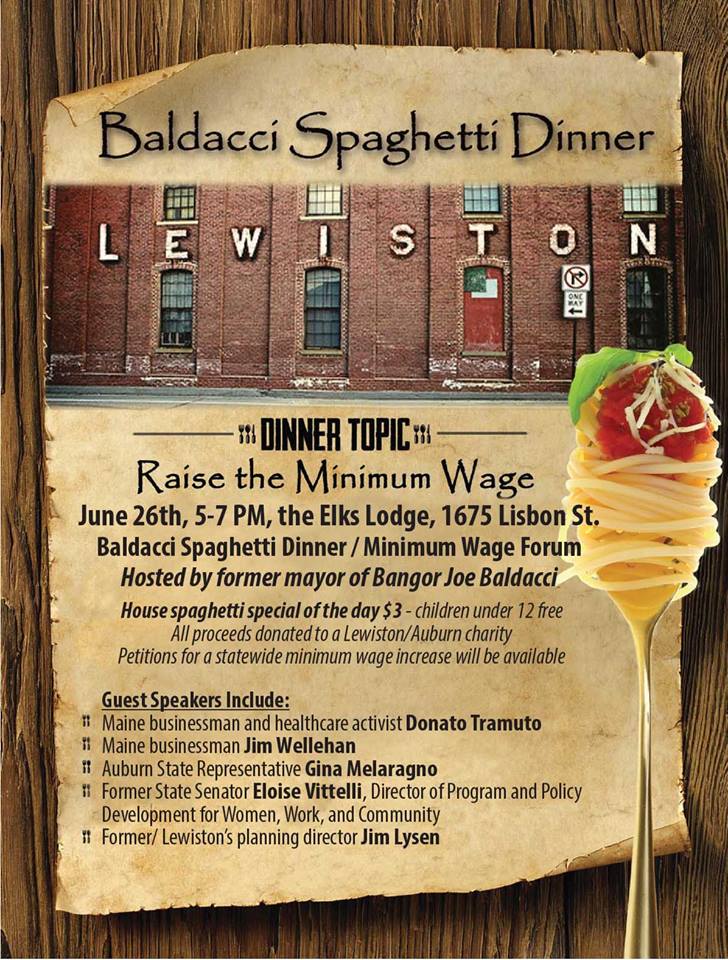
Bangor City Councilor Joe Baldacci hosted his first spaghetti dinner/minimum wage forum on June 26th in Lewiston. He and guests addressed a packed room of over 150 people as attendees finished their spaghetti made from the famous Baldacci family’s recipe.

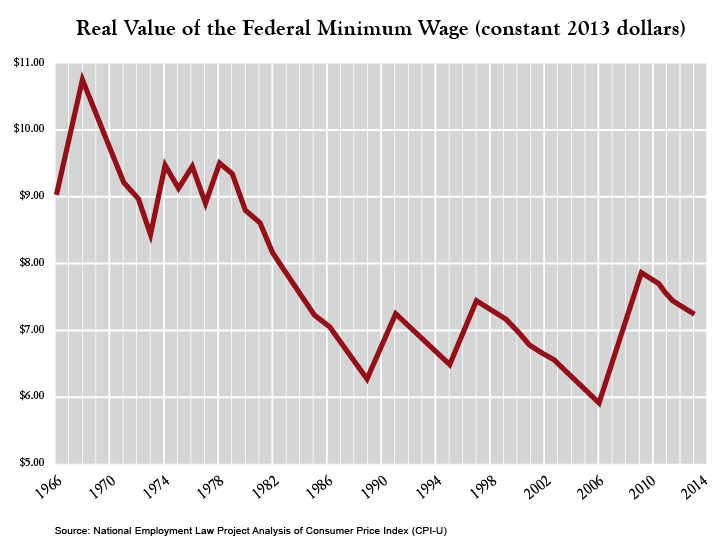
Speakers addressed the economic situation faced by those earning a minimum wage and the need for action. According to the Economic Policy Institute (EPI) the federal minimum wage of $7.25 is worth $2 less today than it was in 1968 when adjusted for inflation.

Economist Garrett Martin, of the Maine Center of Economic Policy, analyzed how the economic situation coming out of the Great Recession has led to low wage earners truly being left behind. He explained that a minimum wage raise would lift everyone up.

“Don’t believe them when they tell you raising the wage costs jobs… It actually boosts the economy. The last time the federal government raised the minimum wage over $5.5 billion more was spent,” said Martin. “And jobs were created.” Continue reading

Middle-class economics spoken here at Baldacci Lewiston spaghetti dinner

Middle-class economics spoken here – Joe Baldacci’s Op=ed in the Lewiston Sun Journal

joeat_lawofficesmilingBangor City Councilor Joe Baldacci | Sunday, June 21, 2015

I want to invite people to attend a Baldacci Spaghetti Supper beginning at 5 p.m. on Friday, June 26, at the Elks Lodge, 1675 Lisbon Road in Lewiston.

Noted local and statewide speakers will discuss the minimum wage and middle-class economics. The dinner will be an opportunity for local and state leaders to celebrate unity and discuss middle-class issues in Lewiston.

All proceeds will benefit New Beginnings, which helps at-risk young people in the Lewiston-Auburn area.

I look forward to serving up a lot of spaghetti to the good people of Lewiston-Auburn.

The L-A economy and community are at a crossroads that requires unity and leadership to open the Twin Cities to new beginnings and more prosperous times.

Lewiston-Auburn has a proud working-class history and has shown signs of revitalization. But, with tough economic circumstances continuing to affect the region, leaders with bold policies are needed to address underlying community and economic challenges.

According to the 2013 American Community Survey results of the U.S. Census Bureau, 34 percent of K-12 students in Lewiston are living below the poverty level, with some schools nearing astronomical poverty levels.

A shocking 98 percent of students at Gov. James B. Longley Elementary School are eligible for free or reduced-cost lunch, eligibility for which is determined by the poverty level.

At Lewiston High School, where approximately 1,400 students attend, there are 132 students identified as being homeless, representing nearly 10 percent of the high schools’ populations.

“It isn’t right,” said Jim Wellehan of Lamey-Wellehan Shoes in a recent conversation I had with him. “These kids are going to bed hungry. One of the biggest determinants of a kid’s success in school is the poverty level. Something needs to be done.”

In my hometown of Bangor, the majority of students also qualify for a free or reduced-price lunch and the numbers are similar in many of Maine’s larger service-center communities. I think we, as a state and as a people, can do better.

According to the Bureau of Labor Statistics, 10 percent of Lewiston’s workforce earns less than $9 per hour, which is $1 less than what the Massachusetts Institute of Technology reports as a living wage in Lewiston for single adults, and $10 short of what MIT calculates as a living wage for a single parent.

According to the U.S. Census Bureau, more than one in three children in the Lewiston school system are currently being raised by single mothers. At today’s minimum wage, thousands of single mothers in Lewiston would have to work an unfathomable 116 hours a week simply to survive without government assistance.

Because of the dire social circumstances, low wages, sub-sustenance minimum wages and the rising cost of living, nearly half of Lewiston residents have had no choice but to accept public assistance.

Thankfully, some are heeding Jim Wellehan’s call that “something needs to be done.” Leaders in Lewiston and all across the state are recognizing that there is powerful momentum growing in Lewiston and all over Maine to promote a new and more positive middle-class economic agenda.

They realize we must re-establish a political movement that champions jobs and rising wages, a middle-class movement that recognizes that raising wages for working people helps reward work over welfare in a way more concrete and tangible than anything that is being done in Augusta.

The dinner on June 26 represents what could be a moment of unity for Lewiston-Auburn leaders pushing for a minimum wage increase and other middle-class issues.

The event will bring local leaders, such as Gina Melaragno, Jim Wellehan, New Beginnings Director Bob Rowe and former Lewiston City Planner Jim Lysen, together with state leaders, such as former state Sen. Eloise Vitelli, Maine People’s Alliance representatives and health-care activist Donato Tramuto, in a way that will engage the community in a conversation on middle-class issues.

Highlighted at the event will be the Maine Peoples Alliance’s petition drive to gradually increase the minimum wage to $12 an hour, a figure that would bring enormous benefits to Lewiston-Auburn.

More than 25 percent of the Lewiston-Auburn’s workforce would receive an immediate raise if the minimum wage were to increase to $12 per hour.

Joe Baldacci is a former mayor and councilman of Bangor. He lives in Bangor.

Myths about the minimum wage and the truths

laborr22ALL DATE: THE U.S.DEPARTMENT OF LABOR

MYTH: Raising the minimum wage will only benefit teens.

NOT TRUE: The typical minimum wage worker is not a high school student earning weekend pocket money. In fact, 88 percent of those who would benefit from a federal minimum wage increase are age 20 or older, and 55 percent are women.

———————————————————————————————-
MYTH: Increasing the minimum wage will cause people to lose their jobs.

NOT TRUE: A review of 64 studies on minimum wage increases found no discernable effect on employment. Additionally, more than 600 economists, seven of them Nobel Prize winners in economics, have signed on to a letter in support of raising the minimum wage to $10.10 by 2016. Continue reading

Increasing the minimum wage means “we the people” value people

Jensen Cook. Photo by Jeff Kirlin

Jensen Cook. Photo by Jeff Kirlin

“My goal is to help bring meaningful reform to our criminal justice system in America. I want to put an end to this country’s school to prison pipeline that so many minorities and people living in poverty face.

“Ya know, I really do love my job; not many people my age can say that. However, I’m in a situation where I can’t go back to college because I have bills to pay. I’m constantly being pressured by my family to go back to school, but how am I supposed to balance a college education with rent? It’s frustrating being criticized by some of the people you love most, but what’s even worse is having to delay my goals because I work for less than $9 an hour. How am I supposed to help those living in poverty when I can’t even find a way to get out of poverty myself?” asked Jensen Cook.

Valuing people—

The Framers of the U.S. Constitution set forth the fundamental basis for our government, using the concept of the “social contract,” according to which human beings begin as individuals in a state of nature and create a society by establishing a contract whereby they agree to work to live together in harmony for their mutual benefit.

Raising the minimum wage is all about how much the lives and livelihoods of hard-working people are valued. Under the New Deal-era social contract people were valued.

“No business which depends for existence on paying les than living wages to its workers has any right to continue in country,” said President Franklin D. Roosevelt when the federal minimum wage was signed into law in 1938. When questioned about what he meant by a “living wage” the President said, “By living wages, I mean more than the bare subsistence level. I meant the wages of a decent living.” Continue reading

Increasing the minimum wage saves taxpayers’ funds—

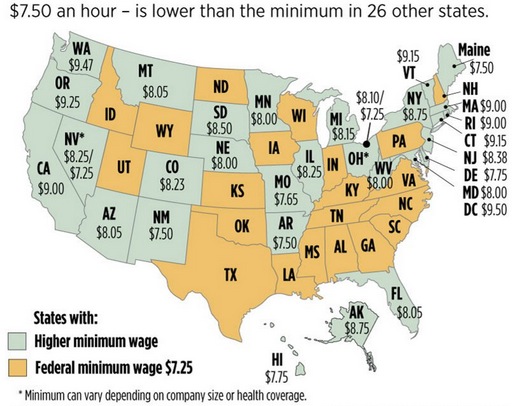
Screen Shot 2015-06-01 at 3.46.04 PMCurrently the minimum wage in Maine is in no way a livable wage, even though at $7.50 it’s 25 cents more than the federal minimum wage—how could it be? In fact it forces far too many onto welfare roles and the need for federally subsidized healthcare.

For years, nationally, companies like Wal-Mart have created internal policies that have kept their workers in the margins, so these corporations wouldn’t have to pay their own employees health-care benefits. Caught in a cycle of not being able to earn enough for their families, on a minimum wage, too many workers have had to turn to federal help.

According to a report from Americans for Tax Fairness, a nonprofit that advocates for tax reform, American consumers subsidize Wal-Mart to the tune of $6.2 billion per year, through public assistance. Workers have to rely on food stamps (SNAP), low-income housing, and other taxpayer-funded welfare programs. Continue reading

ME’s statewide efforts to increase the minimum wage

wcap22 copy
Maine lawmakers proposed eight bills to raise the wage—

Lawmakers on March 23rd held public hearings in Augusta on eight separate proposed bills related to raising the minimum wage. During the last legislative session, Governor Paul LePage vetoed all minimum-wage bills.

“We need to raise wages across the board. All throughout Maine, working families are living paycheck to paycheck and struggling to make ends meet. Workers’ wages are simply not keeping pace with rising costs. Raising the minimum wage is a first step in a larger effort to build an economy that works for everyone, not just the wealthy few,” stated Maine AFL-CIO Executive Director Matt Schlobohm.

Many small business owners testified in favor of a wage increase. Continue reading

Increasing the minimum wage is good for the economy—

Screen Shot 2015-04-01 at 12.11.55 PMThe call to increase the minimum to $10.10 has made progress—

The minimum wage was increased in 20 states and the District of Columbia on January 1, 2015. Laws and automatic adjustments were made official with the start of the New Year. That means 29 states have minimum wages above the federal minimum of $7.25 an hour.

When President Barak Obama was reelected, he put out a call for the federal minimum wage to be increased to $10.10 an hour and for private companies to take the initiative and raise wages independently. Soon after, Obama established an executive order giving federal workers that raise. His actions spurred some companies, legislatures, cities, and governors to take similar action.

In the 13 states that boosted their minimum wages in January 2014, the number of jobs grew an average of 0.85 percent from January through June. The average for the other 37 states was 0.61 percent.

“One out of four workers in Maine’s Second District—almost 60,000 workers—would benefit from an increase in the minimum wage to $10.10 an hour, as proposed by President Obama,” said Bangor City Councilor Joe Baldacci.

According to the Congressional Budget Office (CBO), in 2014 the cost-benefit to the economy would be 49 to 1 meaning — an extra dollar in worker’s wages, brings $49’s worth to the economy. The CBO estimated that raising the minimum wage to $10.10 and indexing it to inflation would increase the wages of 16.5 million workers.

On March 26, 2014, Connecticut passed legislation to raise the minimum wage from $8.70 to $10.10 by 2017, the first state to address President Obama’s call for an increase in the minimum wage.

Minimum-Wage-2013-newAccording to the Economic Policy Institute (EPI), the federal minimum wage of $7.25 is worth $2 less today than it was in 1968, when adjusted for inflation. The EPI study found a full-time worker would need to earn $11.06 an hour in 2011 to keep a family of four out of poverty.

A person working 40 hours a week at the federal minimum wage of $7.25, would earn $290 each week—or $15,080 per year—$4,610 below the federal poverty level.

The Pew Center reported in January 2014 that 73 percent of Americans supported raising the minimum wage from $7.25 to $10.10 per hour. By political party, 53 percent of Republicans (mostly women) and 90 percent of Democrats favored this minimum wage increase.

The value of the minimum wage has been so severely eroded that businesses today are paying minimum wage workers 23 percent less than they were in the 1960s, while other areas of the economy have grown substantially. Over the past 50 years, the minimum wage has seen little to no growth as worker productivity has surged. Continue reading

Cities are now taking the lead— to increase the minimum wage

From an article in Maine Insights by Ramona du Houx

Bangor, Maine is considering an increase in the minimum wage proposed by former Mayor Joe Baldacci.

Bangor, Maine is considering an increase in the minimum wage proposed by former Mayor Joe Baldacci.

On June 2, 2014, the City Council of Seattle, Washington, passed a local ordinance to increase the minimum wage of the city to $15 an hour. As of 2015, Los Angeles, San Francisco, Chicago, and Oakland, California, have approved increases, in the case of Los Angeles to $15 an hour by 2020.

• Twenty-two cities nationally have created their own minimum wage, according to the National Employment Law Project, a New York City nonprofit.

• A 2013 Center for Economic and Policy Research (CEPR) review of multiple studies since 2000 indicated that there was “little or no employment response to modest increases in the minimum wage.”

• Another CEPR study in 2014 found that job creation within the United States is faster within states that raised their minimum wage. In 2014, the state with the highest minimum wage in the nation, Washington, exceeded the national average for job growth.

• The CEPR study indicated 11 reasons for this finding, including high reductions in labor turnover and vast improvements in organizational efficiency.

• The nonpartisan Economic Policy Institute (EPI) projects that if the minimum wage rises from $8 to $9, everyone currently earning $9 would be bumped up to $10, as employers adjust their pay scales.

• The Economist, not know for progressive views, wrote in December 2013, “A minimum wage, providing it is not set too high, could thus boost pay with no ill effects on jobs.”

There are various proposals to increase the minimum wage in Maine cities. Continue reading

Maine business statements for a living wage

Zeth, and Betsy Lundy with their children

“Being a small business owner is hard, and paying a living wage is never easy, but I don’t think we could be completely proud of the business we have built and its role in the community if we weren’t paying our employees a living wage.

“There have been times that we have not paid ourselves so that we can pay our employees an amount of money that they can live on, but I wouldn’t have it any other way.

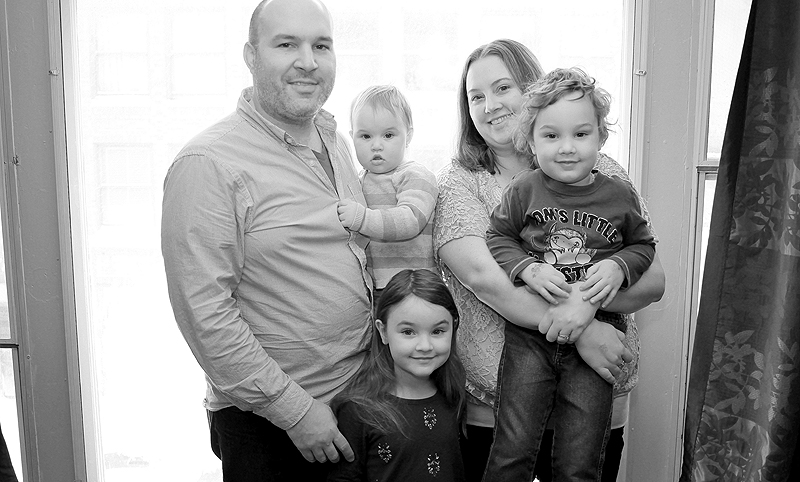
“We are successful because of who they are and because of their commitment to making this store work. We aspire to offer them more, and would be embarrassed to offer them less than a living wage,” said Zeth and Betsy Lundy. Photo by Jeff Kirlin.

With most of the economic recovery since the recession benefiting the highest wage earners, people earning a minimum wage have been drastically left behind, according to the Maine Center for Economic Policy (MCEP).

“Raising the minimum wage is critical to decreasing childhood poverty,” said Jim Wellehan, founder and owner of Lamey-Wellehan Shoes, who attended a Bangor Town Hall about the minimum wage. “It isn’t right to allow working mothers and Maine’s people to work at today’s low minimum wage.” Continue reading

About this site: Raise the Minimum Wage for Maine

This slideshow requires JavaScript.

The photographic series above, People at Work: The Low Wage Earners of Maine, depicts some of our fellow neighbors who work for the state’s minimum wage of just $7.50 an hour. The dedicated photographer, Jeff Kirlin, works in his free time documenting them and has set up #MaineLivingWage #RaiseTheWage to share them.

This website is dedicated to raising awareness about how the current minimum wage is a poverty wage. We will chronicle statewide events and bring you updates on the efforts to raise Maine’s minimum wage— until a livable minimum wage for Maine is achieved.

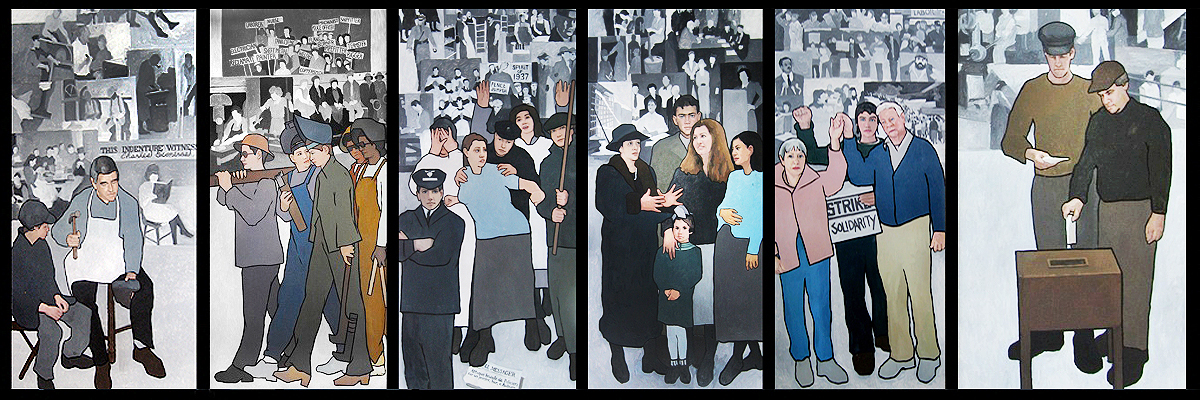
Panels from Maine artist Judy Taylor’s Labor Mural, that was commissioned by Maine’s Department of Labor.

Panels from Maine artist Judy Taylor’s Labor Mural, that was commissioned by Maine’s Department of Labor.

According to the non-partisan Economic Policy Institute (EPI) the federal minimum wage of $7.25 is worth $2 less today than it was in 1968 when adjusted for inflation. An Alliance for a Just Society estimates that $15.82 would be a livable wage. Maine’s current minimum wage forces far too many families onto welfare rolls and the need for federally subsidized healthcare.

Someone working 40 hours a week at the federal minimum wage of $7.25, would earn $290 each week—or $15,080 every year—$4,610 below the federal poverty level. According to the Massachusetts Institute of Technology’s local wage calculator, at today’s minimum wage a single mother in Maine would have to work 138 hours per week just to survive without government assistance programs like Medicaid and the SNAP (food stamps.)

“Nobody working a 40 hour week should live in poverty,” said Bangor City Councilor Joe Baldacci who last February proposed an ordinance that would incrementally increase the minimum wage to $9.75 in 2018.

11429685_10206817217209646_8883748444359186629_nJoe has also started hosting spaghetti dinners across the state to generate support and awareness for raising the minimum wage, as well as to give people information about the Maine Peoples Alliance’s (MPA) petition drive to steadily increase Maine’s minimum wage to $12.00 an hour There will be upcoming events in Bangor, Portland, Millinocket, and Presque Isle.

“These spaghetti dinners have always been a great opportunity to bring the community together for a family dinner that encourages discussion and unity on important working class issues,” said Joe. “I hope these dinners will help generate a grassroots push for a statewide minimum wage increase.”

City Councilor Baldacci has already held a town forum in Bangor, and spoke on the issue in Waldo County, and Washington County.