ABOUT THIS SITE

This slideshow requires JavaScript.

The photographic series above, People at Work: The Low Wage Earners of Maine, depicts some of our fellow neighbors who work for the state’s minimum wage of just $7.50 an hour. The dedicated photographer, Jeff Kirlin, works in his free time documenting them and has set up #MaineLivingWage #RaiseTheWage to share them.

This website is dedicated to raising awareness about how the current minimum wage is a poverty wage. We will chronicle statewide events and bring you updates on the efforts to raise Maine’s minimum wage— until a livable minimum wage for Maine is achieved.
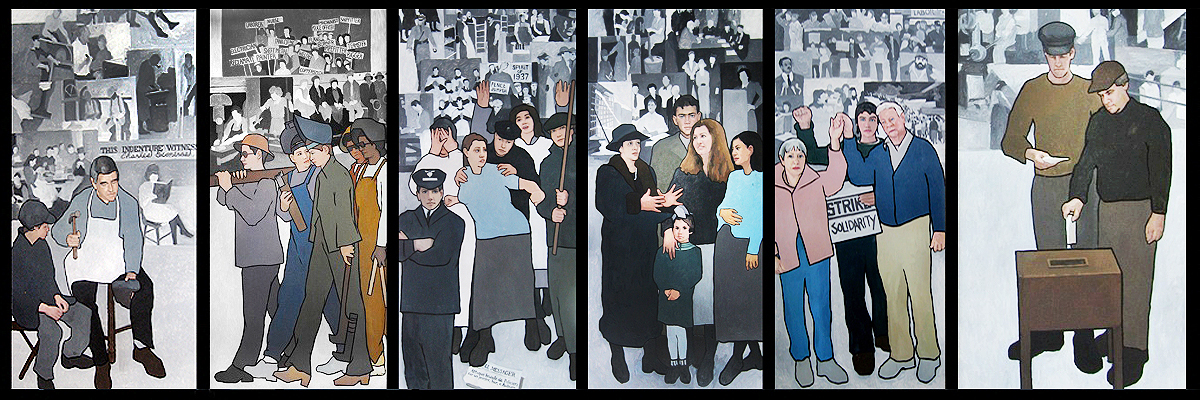
Panels from Maine artist Judy Taylor’s Labor Mural, that was commissioned by Maine’s Department of Labor.

Panels from Maine artist Judy Taylor’s Labor Mural, that was commissioned by Maine’s Department of Labor.

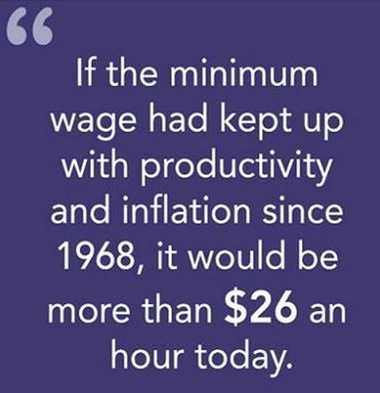
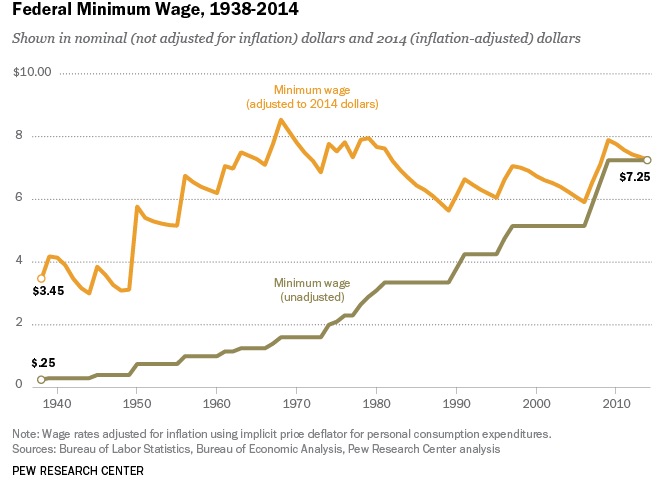
According to the non-partisan Economic Policy Institute (EPI) the federal minimum wage of $7.25 is worth $2 less today than it was in 1968 when adjusted for inflation. An Alliance for a Just Society estimates that $15.82 would be a livable wage. Maine’s current minimum wage forces far too many families onto welfare rolls and the need for federally subsidized healthcare.

Someone working 40 hours a week at the federal minimum wage of $7.25, would earn $290 each week—or $15,080 every year—$4,610 below the federal poverty level. According to the Massachusetts Institute of Technology’s local wage calculator, at today’s minimum wage a single mother in Maine would have to work 138 hours per week just to survive without government assistance programs like Medicaid and the SNAP (food stamps.)

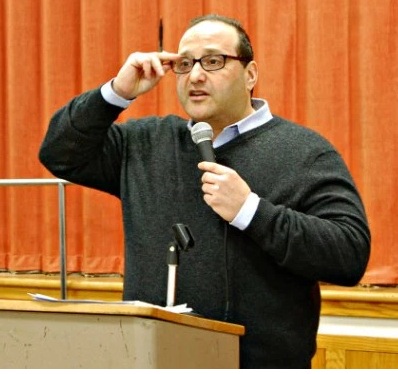
“Nobody working a 40 hour week should live in poverty,” said Bangor City Councilor Joe Baldacci who last February proposed an ordinance that would incrementally increase the minimum wage to $9.75 in 2018.
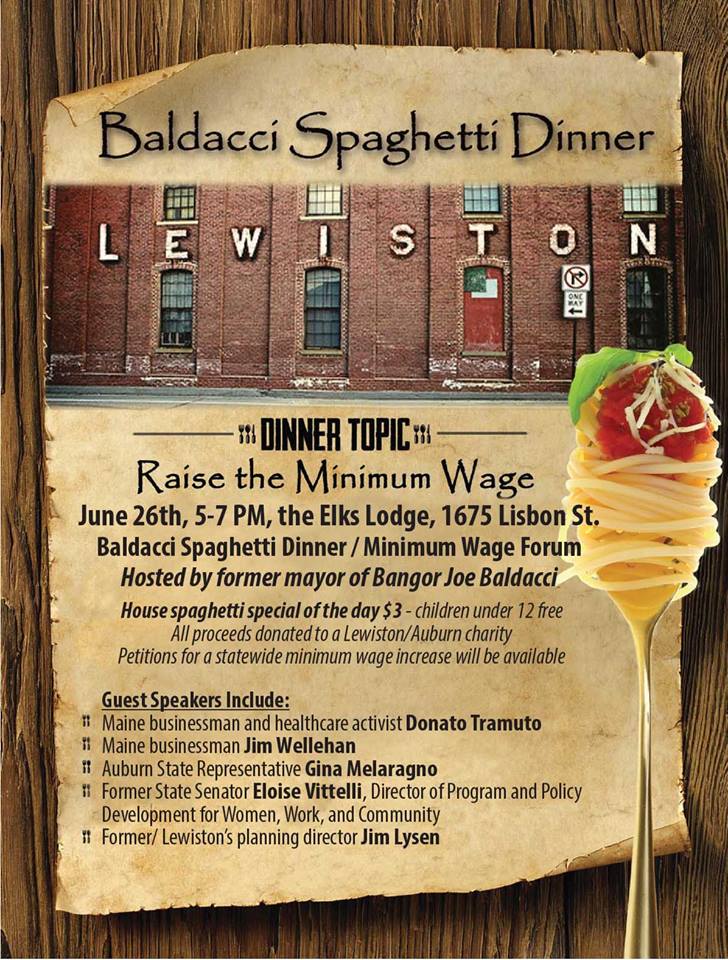
11429685_10206817217209646_8883748444359186629_nJoe has also started hosting spaghetti dinners across the state to generate support and awareness for raising the minimum wage, as well as to give people information about the Maine Peoples Alliance’s (MPA) petition drive to steadily increase Maine’s minimum wage to $12.00 an hour There will be upcoming events in Bangor, Portland, Millinocket, and Presque Isle.

“These spaghetti dinners have always been a great opportunity to bring the community together for a family dinner that encourages discussion and unity on important working class issues,” said Joe. “I hope these dinners will help generate a grassroots push for a statewide minimum wage increase.”

City Councilor Baldacci has already held a town forum in Bangor, and spoke on the issue in Waldo County, and Washington County.
The truth with 5 facts about the minimum wage

From the Pew Research Center-BY DREW DESILVER243 COMMENTS

Screen Shot 2015-07-29 at 11.00.22 AM

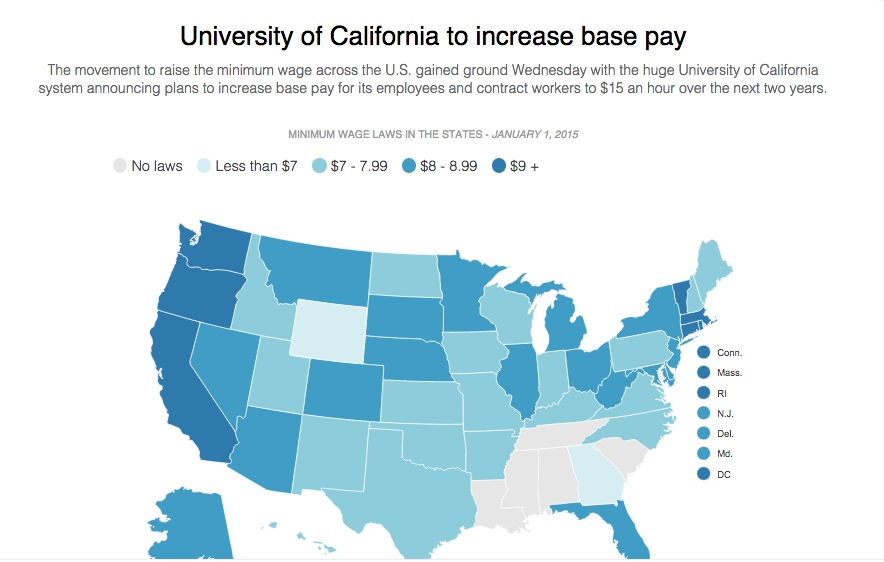
As efforts to raise the federal minimum wage from $7.25 an hour have stalled repeatedly, several states and cities – from Los Angeles to New York state to Washington, D.C. – are acting on their own to raise minimum pay rates. Although some proposals target fast-food workers specifically, organized labor and anti-poverty groups are pushing for $15 an hour as the new standard for all workers paid hourly.

While the idea of raising the minimum wage is broadly popular, a Pew Research Center survey from January 2014 found clear partisan differences in support. Overall, 73% of people favored an increase in the federal minimum to $10.10 an hour, mirroring a Democratic-backed proposal that failed to move ahead in Congress last year. But while large majorities of Democrats (90%) and independents (71%) said they favored such an increase, Republicans were more evenly split (53% in favor and 43% opposed). Continue reading

F.D.R.’s case for the Minimum Wage rings true for raising it too

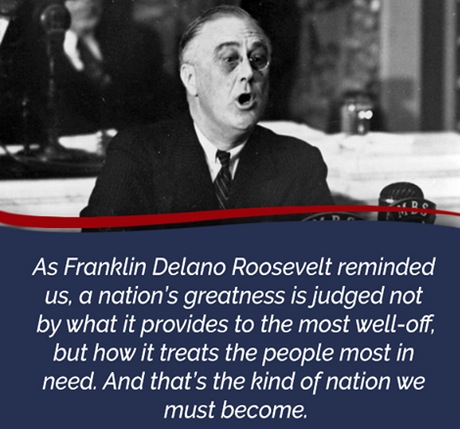
fdrWhat F.D.R. said in 1938 about establishing a minimum wage is also true about raising it: “Without question it starts us toward a better standard of living and increases purchasing power to buy the products of farm and factory.”

From an article in The New York Times

By TERESA TRITCH MARCH 7, 2014

In the more than 75 years since Congress first enacted a federal minimum wage — at 25 cents an hour — lawmakers have increased it nine times, reaching the current level of $7.25 an hour in 2009. And with every increase the same objections have been raised.

Today, instead of dismantling these arguments on my own I decided to get a little help from President Franklin Delano Roosevelt, who had to fight Republicans, conservative Democrats, the Supreme Court and corporate leaders to pass the initial minimum wage in 1938.

Objection: Raising the minimum wage will hurt business and reduce employment.

“No business which depends for existence on paying less than living wages to its workers has any right to continue in this country.” (1933, Statement on National Industrial Recovery Act) Continue reading

Baldacci keeps minimum wage issue alive by delaying action on wage-hike plan

Screen Shot 2015-07-29 at 10.12.46 AM From an article in the BDN by By Evan Belanger

Maine — Without majority support, Councilor Joe Baldacci moved Monday evening to delay consideration of his proposed local minimum-wage increase until after the November election.

Baldacci’s motion came immediately after it became clear he did not have support from Councilor Ben Sprague, who raised questions about how the ordinance would deal with nonprofits, tipped employees, small businesses and other details.

“This would be … a major ordinance change, and I don’t believe we have had time to fully vet it yet,” said Sprague, who called it a great policy debate and thanked Baldacci for leading it. Continue reading

Bangor, Maine should dare to aspire, raise its minimum wage

By Heinrick Snyder

I attended the public discussion on raising the minimum wage in Bangor on July 15 at City Hall. My fellow residents were very articulate in expressing their opinions and concerns on both sides of the issue. But the basic truth is that “all politics are local.”

If our city makes the courageous decision to raise the minimum wage, it will be easier to raise at the state and federal levels. Within the bounds of our local governance, we should not be afraid to exercise ideas that will better our residents and economy. There is too much hope in the experiences of other American communities like Seattle and Los Angeles that enacted such city ordinances. We cannot hesitate in arguments of fear when change will happen anyway. Our choice to change with a heart of hope will grow an economy more than the fear of inflation caused by improving the value our residents’ basic work time. Continue reading

Majority of Bangor community speaks out in favor of proposed minimum wage hike

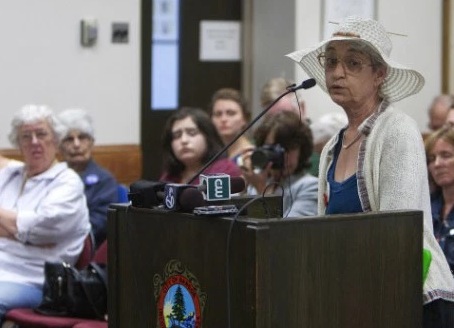
Screen Shot 2015-07-18 at 3.55.55 PMTeresa Montague of Clifton speaks in favor of Councilor Joe Baldacci’s minimum wage proposal Wednesday during a public hearing in the council chambers at City Hall in Bangor.
Ashley L. Conti | BDN
Article in the Bangor Daily News

By Evan Belanger, BDN Staff

BANGOR, Maine — A proposed ordinance to implement a local minimum wage for Bangor won a potential new supporter on the City Council after more than 30 people spoke on the issue during a public hearing Wednesday.

Councilor Gibran Graham, who had previously reserved judgment on the issue, spoke in favor of the ordinance.

“I do want to see it done at the federal level, I want to see it done at the state level,” he said. “But we can’t just wait for it to happen, because it’s not happening.” Continue reading

Huge grassroots support for referendum to Raise Maine’s Minimum Wage

laArticle first appeared in Maine Insights. See
Tremendous grassroots support for referendum to Raise Maine’s Minimum Wage

A Ballot Question Committee quarterly fundraising report filed today by the Maine People’s Alliance (MPA) shows strong grassroots backing for the campaign to raise Maine’s minimum wage. The average individual gave $31.62 and 97 percent of contributors live in Maine.

fwm_design_final_small“Nobody should be working 40 hours a week and be homeless, like my husband and I both were,” said Katie Logue, who works as a gas station cashier for $9 an hour and made a contribution to the campaign. “Raising the minimum wage would mean we could afford a few more of the basics that we sometimes overlook, like health insurance for me, or fixing the car now that it makes this awful noise, or keeping some food in the house. I need to fight for this minimum wage increase because no family should have to work as hard as we do (and harder) to make barely enough to survive.”

$170,055.70 has been contributed during the first phase of the signature collection process to place an increase in the minimum wage on the ballot in 2016. The fundraising totals include in-kind and organizational support as well as contributions from 2,282 individual donors. Continue reading